
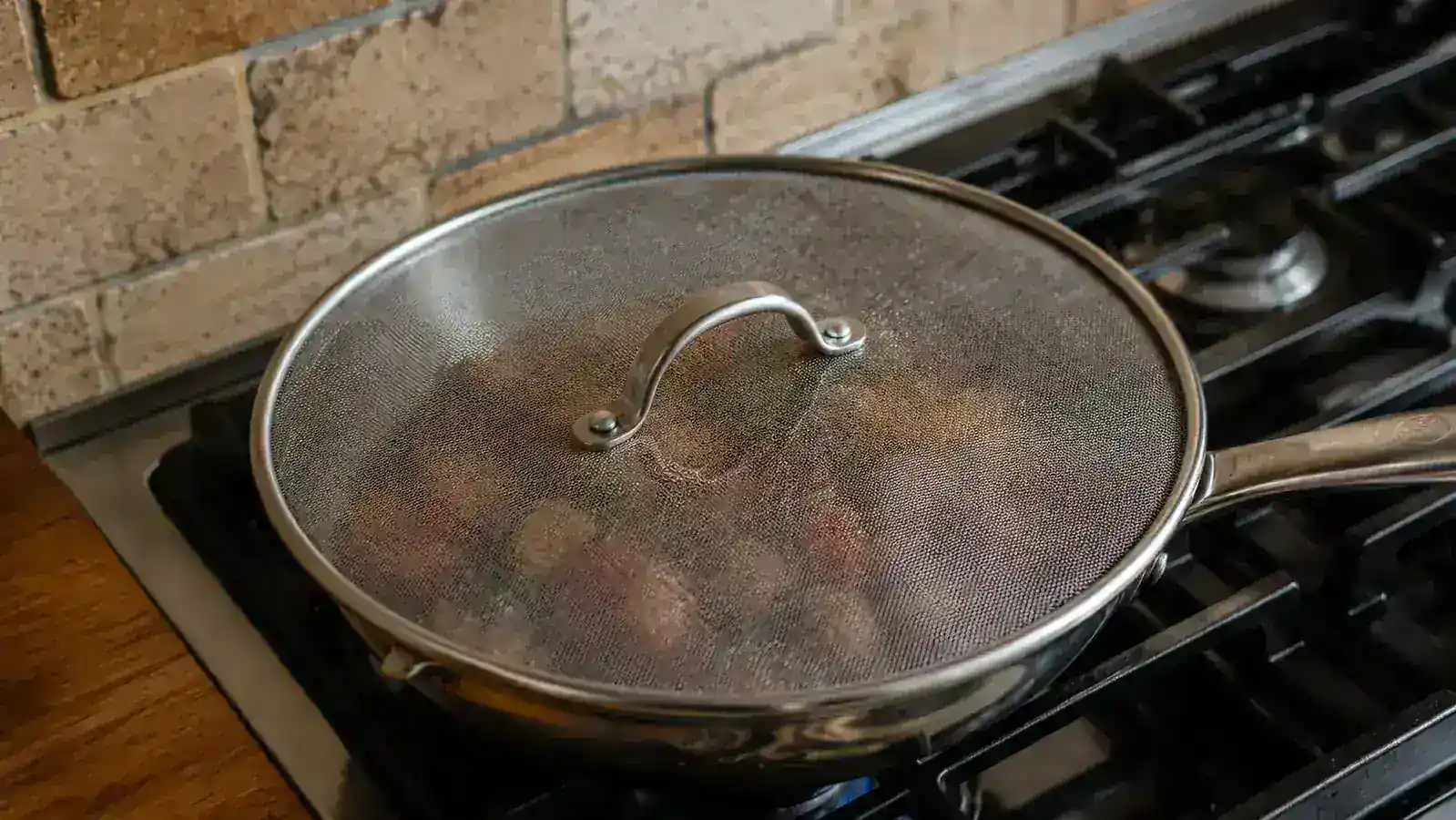
Here is what I wish someone had told me before I ordered a splatter screen: the listing photograph is always shot from directly above, which makes every screen look like it fits every pan. It does not. I ordered a set of three U.S. Kitchen Supply stainless steel splatter screens, and the first thing I did was grab the 11.5-inch screen for my 12-inch skillet. Too small by a solid half inch. Grease still found the gap and landed on the burner grate. That is not a deal-breaker, but it is the kind of thing you need to know going in.
I cook dinner most nights, and the stove shows it. Bacon on weekend mornings, chicken thighs on weeknights, the occasional deep-fry of calamari when I feel ambitious. I have been through three different splatter screens over the years, two of them flimsy single-unit screens that warped within a month, and one pricier OXO version that I lost in a move. When I saw the U.S. Kitchen Supply three-pack sitting at a reasonable price point on Amazon with over 11,000 ratings averaging 4.7 stars, I ordered it and started taking notes.
The Quick Verdict
A well-built splatter screen set that earns its 4.7-star rating, with a few honest caveats about sizing, handle heat, and what 'dishwasher safe' actually means in practice.
Amazon Check Today's Price →If grease on the backsplash is your biggest kitchen annoyance, this is the fix that costs less than two tanks of cleaning spray.
The U.S. Kitchen Supply 3-piece splatter screen set (13, 11.5, and 9.5 inch) is currently one of the better-reviewed options at this price. Check today's Amazon price before you decide.
Amazon Check Today's Price on Amazon →How I Actually Tested These Screens
I am not a food scientist and I did not set up a controlled lab environment. What I did was cook actual meals and pay close attention. Over about six weeks I used these screens for bacon (high splatter, high fat, long cook time), boneless chicken thighs in a little olive oil (medium splatter, unpredictable spitting), frozen shrimp in butter (low splatter but spatters fast when it hits), and a Sunday morning hash that involved both bacon grease and diced onion hitting a very hot pan. I also ran each screen through my dishwasher six times and inspected the mesh and handles for degradation.
For comparison I also did side-by-side tests with a pan lid and with no cover at all. The stovetop I cook on is a gas range with standard-size cast iron grates. If you cook on a flat-top electric or induction cooktop, your splatter behavior will differ slightly because the pan sits lower and the burner edge has a different profile.
I want to be clear about what I am comparing this to: I am not comparing these screens to a commercial mesh screen or to a purpose-built grease guard. I am comparing them to the alternatives a home cook actually considers, which are a pan lid, a cheap single-screen from the dollar store, or nothing.

The Sizing Reality Nobody Mentions
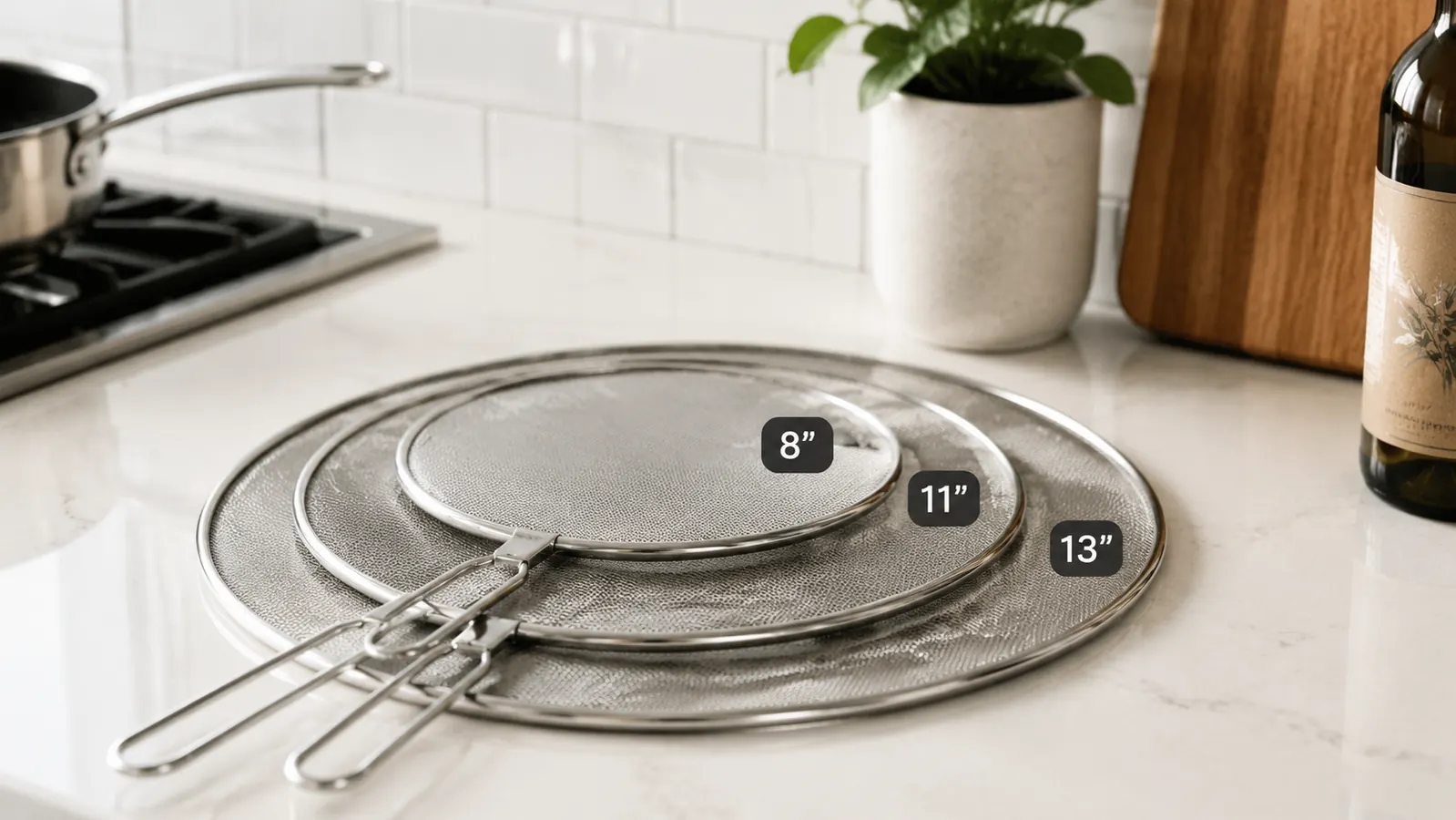
The set comes in three sizes: 13 inch, 11.5 inch, and 9.5 inch. Those are the screen diameters, not the diameter of the pan they fit. Pan sizing in cookware refers to the internal diameter of the cooking surface, but the rim of most skillets adds another inch or more. So a 12-inch skillet, measured rim to rim, is closer to 13 to 13.5 inches across. The 13-inch screen fits my 12-inch skillet properly, with the rim resting on the pan edge all the way around. The 11.5-inch screen fits my 10-inch sauté pan well. The 9.5-inch screen works on my 8-inch egg pan.
The mismatch I ran into initially was operator error combined with a misleading mental model of how screens are sized. Once I matched the 13-inch screen to my large skillet, the coverage was complete and the gaps disappeared. If you are buying this set and you regularly cook in a 12-inch skillet, use the 13-inch screen. If your everyday pan is a 10-inch, the 11.5-inch is your screen. Size up when in doubt.
The mesh is tight enough that almost nothing gets through, but the screen diameter has to actually cover the pan rim or the whole thing is pointless. Size up if you are ever in doubt.
What the Mesh Actually Does (and Does Not) Block
The mesh on these screens is genuinely fine. Finer than I expected at this price. When I fried bacon with the 13-inch screen in place, the underside of the screen caught a visible layer of small grease droplets, but the stovetop surface stayed clean. That is the core job, and it did it well. Cooking at medium-high heat with bacon fat, I saw almost no grease reach the surrounding stovetop. The burner grates under the pan still caught some fat that ran down the pan sides, but that is not what a splatter screen is designed to address.
Here is what the mesh does not block: steam. Steam passes through freely, which is the whole point. Unlike a lid, a splatter screen lets moisture escape so you do not end up steaming your food when you want a sear. This matters most with chicken skin and anything you want a crust on. I noticed a real difference in chicken thigh texture compared to using a lid: the skin stayed crisp under the screen. Under a lid, it steams soft.
The one scenario where the mesh falls a little short is very vigorous high-heat searing, the kind where the pan is screaming hot and you are deliberately trying to create a crust in under two minutes. At that heat and speed, some micro-droplets do pass through the mesh. Not many, not enough to dirty the stovetop in any meaningful way, but enough to notice. If you are doing steakhouse-style searing at maximum heat, no consumer splatter screen will give you perfect containment. These screens are optimized for the realistic range of home cooking temperatures.
The Handle: Better Than Most, But Read This First
The handle is stainless steel, riveted to the screen frame, with a hanging loop at the end for storage. The rivet construction is solid, nothing wobbles. But stainless steel conducts heat, which means after about eight to ten minutes over a medium gas flame, the handle is too hot to grip bare-handed. I burned my fingertips twice in the first week before I learned to keep a folded kitchen towel nearby.
This is not unique to U.S. Kitchen Supply. It is the fundamental tradeoff of all-metal handles: they are durable, they do not degrade in the dishwasher or warp from heat, and they are fine for short cooks. But for anything that stays on the stove longer than five minutes, you will want to use a towel or oven mitt. The listing does not warn you about this. Cheaper screens use silicone or rubber grip sleeves on the handle, which solve the heat problem but tend to crack and smell after a year of dishwasher cycles. There is no perfect answer here; it is a material tradeoff.
My workaround: I keep a folded dish towel next to the stove whenever I am frying, which I was already doing for pan-grabbing anyway. The handle is long enough that you rarely need to touch the part closest to the mesh, and that distal half-inch stays cooler longer. After some trial and error I grabbed it further out by instinct.
Dishwasher Reality Check
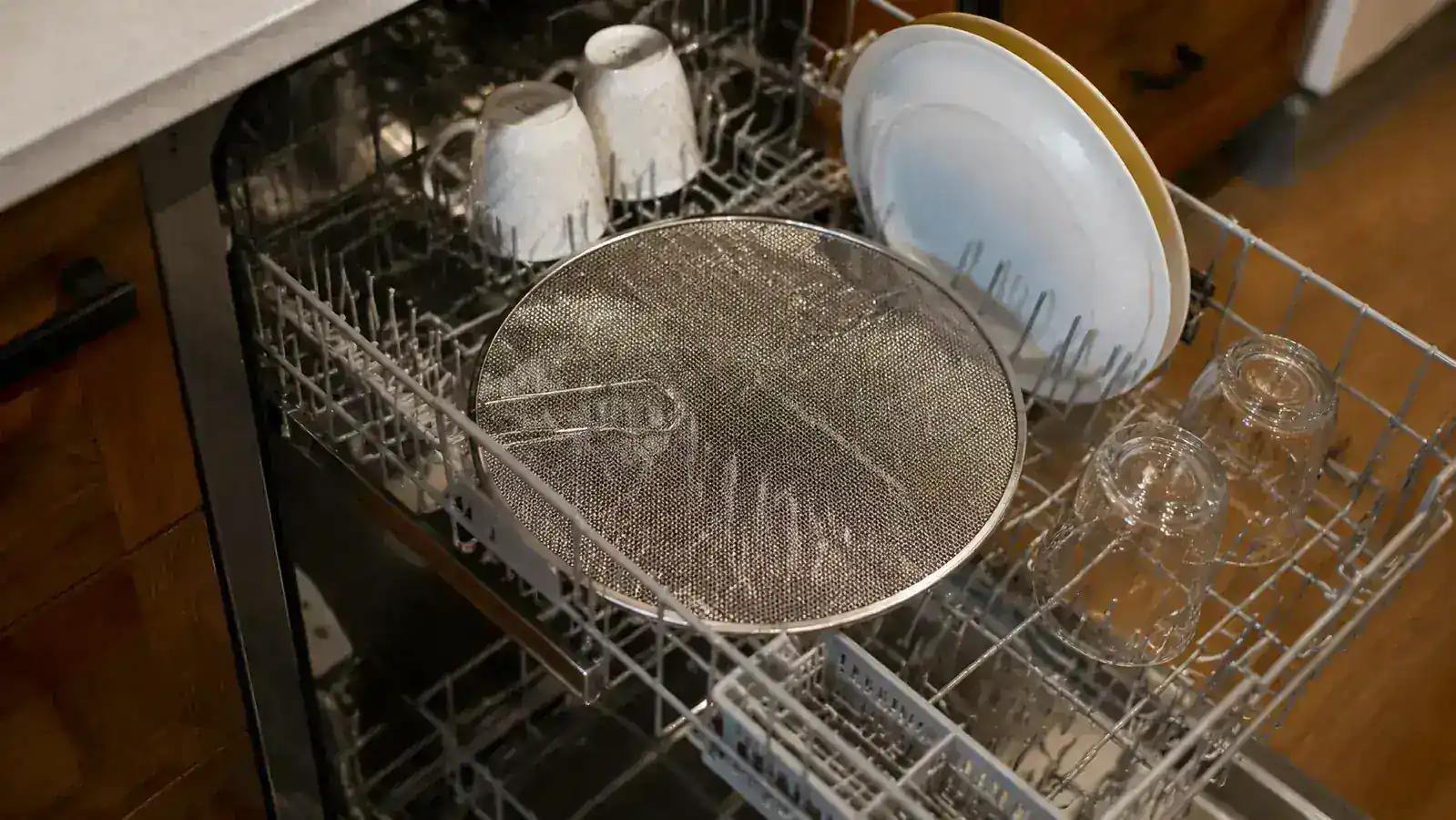
The product description says dishwasher safe, and I ran each screen through six cycles to find out what that actually means. The short version: the mesh survived without any deformation or rust, the stainless steel frame held its shape, and the rivets did not loosen. What did happen is that baked-on grease in the mesh weave did not come fully clean in the dishwasher on the first pass. After frying bacon, a light film of polymerized grease stayed in some of the mesh cells even after a hot-water dishwasher cycle.
The fix is to rinse the screen under hot running water immediately after you take it off the pan, before the grease cools and sets. Once you do that, the dishwasher handles the rest with no trouble. If you let it sit and cool down first, plan to scrub with a brush under hot water before loading. This is not a flaw exactly, it is just how cooking grease works. Every screen and every pan with baked-on fat needs the same pre-rinse discipline.
The screens lay flat in the top rack of my dishwasher alongside dinner plates, which works fine. They are rigid enough that they do not flop over or block the spray arm. After six cycles all three screens looked nearly identical to when I took them out of the box. No discoloration, no rust, no warping.
How It Compares to Just Using a Lid
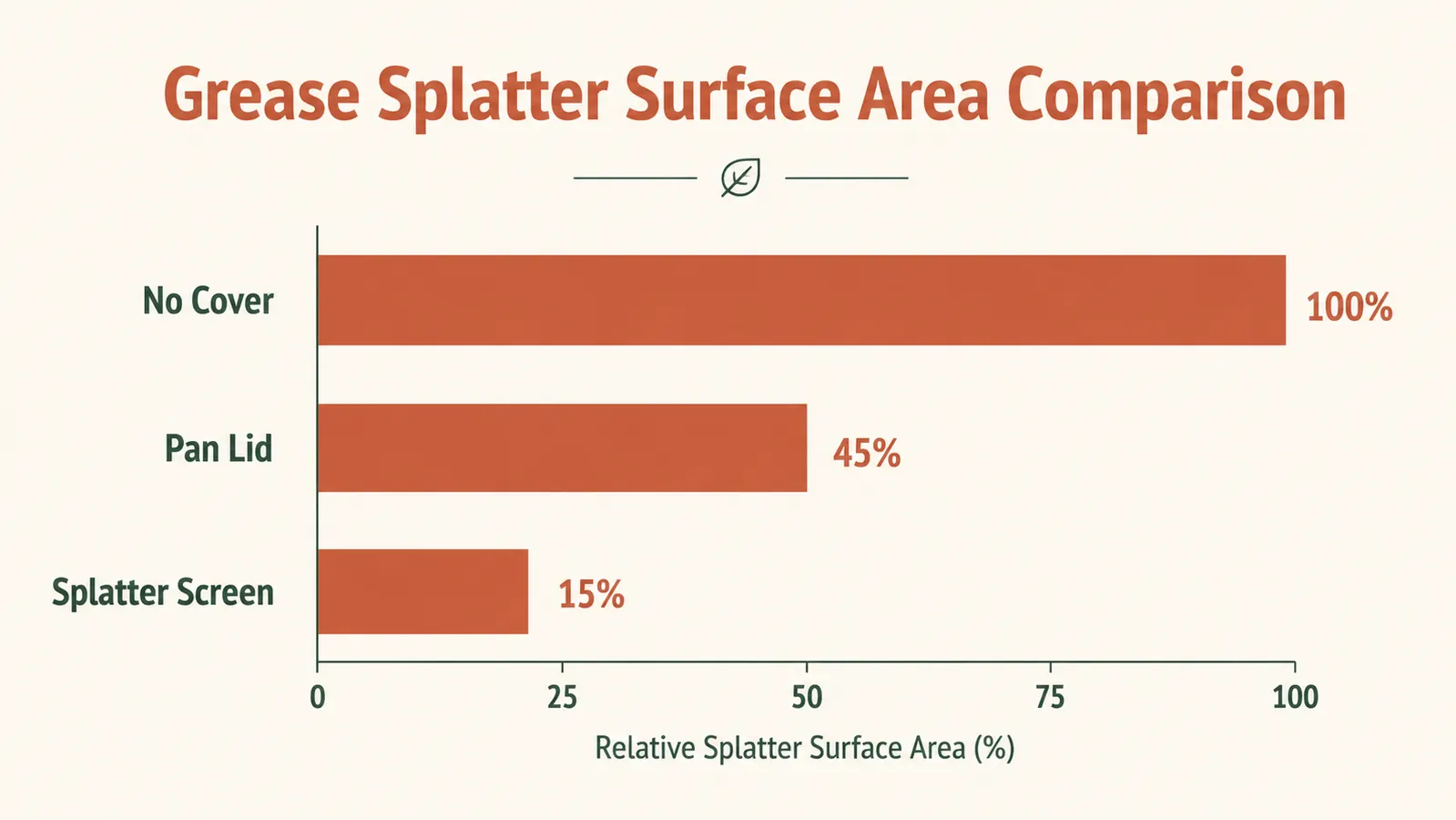
Most home cooks who do not own a splatter screen default to a pan lid when things start spitting. A lid does stop grease splatter, but it creates two problems. First, the steam that should be escaping stays in the pan and condenses back onto the food, making crispy things soggy and preventing browning. Second, when you lift the lid, a rush of steam hits you and the condensed water drips right back into the hot fat, causing a spike in popping. If you have ever had that happen with bacon, you know the feeling.
A splatter screen sidesteps both problems. Steam exits, food browns, and lifting the screen is far less dramatic than lifting a lid because there is no collected condensation to release. From a pure functionality standpoint, a mesh splatter screen is the correct tool for frying and sautéing, and a lid is the correct tool for simmering and braising. They are not substitutes for each other, even though most home cooks use them interchangeably.
Pros and Cons, Without the Spin
What I Liked
- Fine mesh catches micro-droplets that most cheaper screens let through
- Three sizes cover the full range of standard home pans
- Stainless steel construction does not warp or rust after repeated dishwasher cycles
- Solid rivet construction, no handle wobble even after months of use
- Steam passes through freely, so food browns properly instead of steaming
- Flat profile stores easily in a drawer or hung on a pot rack
Where It Falls Short
- All-metal handle gets hot after 8-10 minutes over a flame; keep a towel nearby
- Screen diameters run slightly smaller than pan names suggest; size up if uncertain
- Baked-on grease in mesh needs a hot-water pre-rinse before dishwasher or it does not fully clean
- The 9.5-inch screen is almost too small to be regularly useful in most kitchens
Who This Is For
This set is a strong buy if you cook with oil or fat on a regular basis and you are tired of spending five minutes wiping down the stovetop after every meal. It works especially well for households that cook a lot of bacon, chicken, ground beef, or anything else that spits aggressively. The three-size format is genuinely useful if you use pans of different sizes throughout the week, rather than buying one screen and hoping it sort of fits.
It is also a good pick for cooks who care about getting a proper sear or crispy skin, because the steam-venting design does not sacrifice browning the way a lid does. If texture matters to you more than just splatter containment, a splatter screen is the right tool and this set is a solid version of it.
Who Should Skip It
If you mostly boil, steam, or use an Instant Pot, a splatter screen will sit in your drawer unused. It is a single-purpose tool that only earns its keep at the stovetop with open-pan high-heat cooking. If your kitchen counter or drawer space is already maxed out and you rarely fry, this is not the purchase that will change your cooking life.
Also, if you have a habit of touching pan handles bare-handed out of instinct, the metal handle on this set will catch you off guard until you form a new habit. That is a solvable problem with a towel or a silicone handle sleeve, but it is worth being honest about. Some cooks would rather have the slightly less durable silicone-grip alternative just to avoid that friction entirely.
For the curious: I looked at a couple of budget single-screen options before landing on this set, and the mesh quality on those was noticeably coarser. You could see through it in a way that the U.S. Kitchen Supply mesh does not let you. Coarser mesh means larger droplets get through. At the price difference between a cheap single screen and this three-pack, the value case for the three-pack is easy to make.
Stop wiping down the stovetop after every fry session and get the right tool for the job.
The U.S. Kitchen Supply 3-piece set covers every pan size you cook with and holds up to the dishwasher. Check today's Amazon price to see if it fits your budget.
Amazon Check Today's Price on Amazon →