

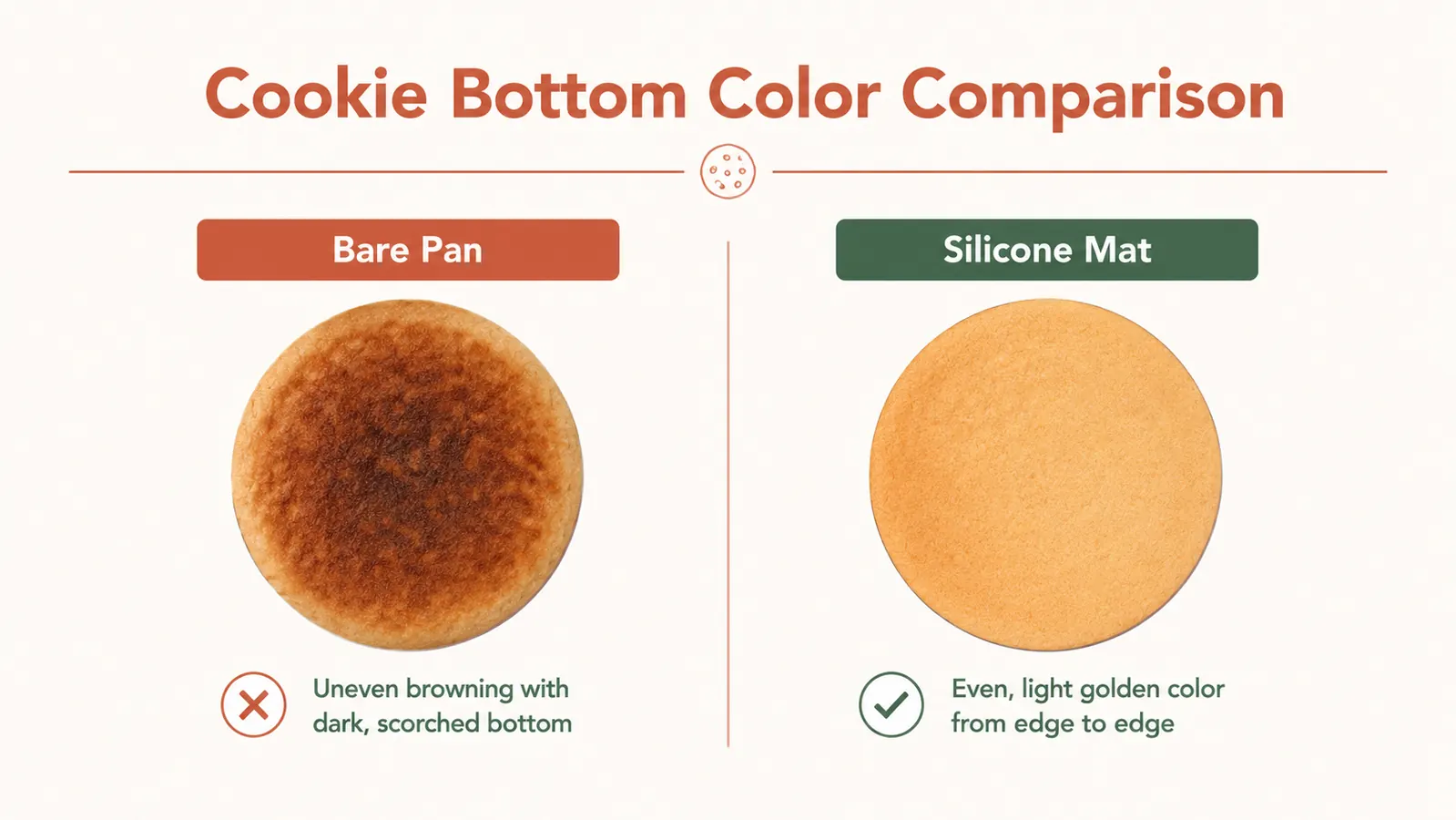
Every home baker has had this experience. You pull a fresh tray of cookies out of the oven and flip one over. The top is golden and gorgeous. The bottom is nearly black. You did not change the recipe. You followed the temperature exactly. And yet another batch is ruined at the last possible moment. The problem is almost never the recipe or the oven temperature. It is the surface the dough is sitting on. Bare metal pans conduct heat unevenly, concentrate it along the pan bottom, and scorch the cookies before the centers have a chance to fully set. A silicone baking mat solves that by acting as a gentle heat buffer between the metal and the dough, so the bottom of every cookie bakes at the same rate as the top.
This guide walks through the complete process for using a silicone baking mat to get consistently even, properly baked cookies. I use the Amazon Basics silicone baking mat for this and have for well over a year. It is inexpensive, fits a standard half-sheet pan, and has not warped or peeled once. If you want the short version before diving into the steps: lay the mat flat on a rimmed sheet pan, portion your dough at room temperature, bake in the center rack at your recipe's called temperature, and let the cookies cool on the mat for two minutes before moving them. That is the whole method. The steps below explain why each part matters and what to watch out for.
If burnt bottoms are wasting your batches, this inexpensive mat is the fix.
The Amazon Basics silicone baking mat (ASIN B077XTPWZ5) has 25,000+ ratings at 4.7 stars. It fits a standard half-sheet pan and is the tool this guide is built around.
Amazon Check Today's Price on Amazon →Step 1: Choose the Right Pan and Mat Size
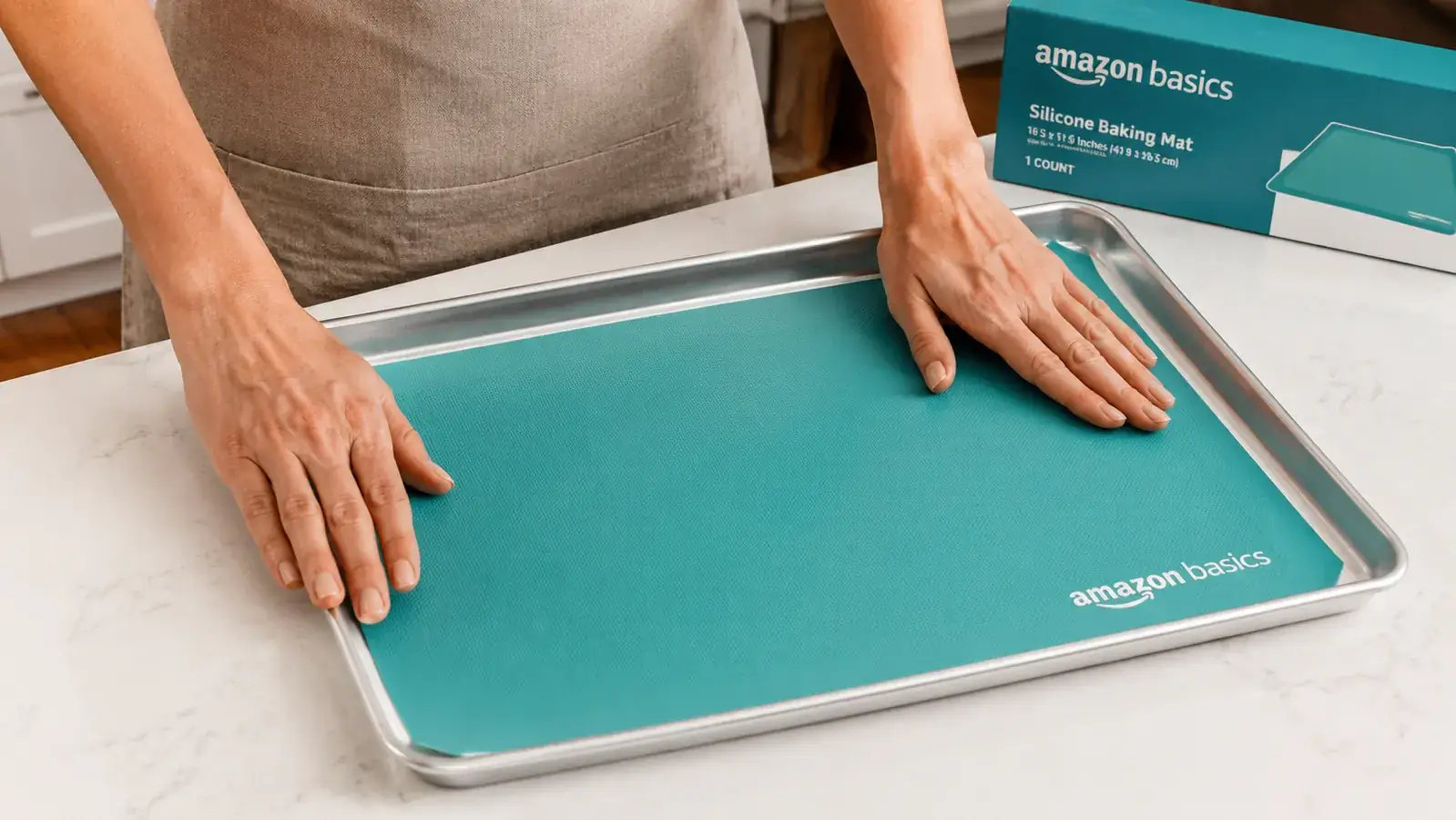
Silicone baking mats come in a few standard sizes. The most common one for home baking is a half-sheet mat, designed to fit inside a standard 18-by-13-inch rimmed half-sheet pan. If you try to lay a half-sheet mat on a smaller quarter-sheet pan it will buckle at the edges and create uneven heat pockets, which defeats the purpose. If you put it on a pan that is too large, exposed bare metal around the edges will still overheat.
So before anything else, measure your pan. The Amazon Basics mat I use measures approximately 16.5 by 11.6 inches and sits flat with a small gap around the inner rim of a standard half-sheet pan. That gap is intentional. The mat does not need to touch the rim, it just needs to lie completely flat on the pan floor with no curling at the corners. If yours has a slight curl from being rolled in the package, lay it flat on the pan and give it ten minutes at room temperature before you start baking. It will relax.
If you only have a small quarter-sheet pan, look for a quarter-sheet sized silicone mat. Do not force a large mat to work on a small pan. The fit matters more than most people realize.
Step 2: Place the Mat Correctly Before Portioning Dough
Lay the mat smooth-side up on the pan before you scoop any dough. This sounds obvious but there is a common mistake here: some bakers try to move a mat that already has cookie dough on it, and the dough slides or spaces shift. Lay the mat first, confirm it is sitting flat with no raised edges, and then start portioning.
You do not need to grease a silicone mat. No butter, no cooking spray, nothing. The non-stick surface handles it. In fact, greasing a silicone mat can leave a residue over time that eventually gets tacky and hard to remove. Leave it ungreased. The cookies will release cleanly on their own.
You do not need to grease a silicone mat. No butter, no spray, nothing. Greasing it actually causes more problems than it solves over time.
Step 3: Use Room-Temperature Dough, Not Dough Straight from the Fridge
If your cookie dough has been chilling in the refrigerator, take it out about 15 to 20 minutes before baking. Cold dough goes into the oven stiff and takes longer for the center to warm through, which means the outside base is exposed to heat longer before the center sets. This extra exposure time is one reason people get burnt bottoms even with a mat. The mat helps, but it cannot completely compensate for dough that is 40 degrees colder than the room.
Slightly warmed dough also spreads more predictably, which gives you a more consistent shape and thickness across the batch. Consistent thickness is directly related to even baking. Thick lumps and thin flat coins on the same tray will never bake uniformly, mat or no mat.
Step 4: Space Dough Evenly and Use the Center Oven Rack
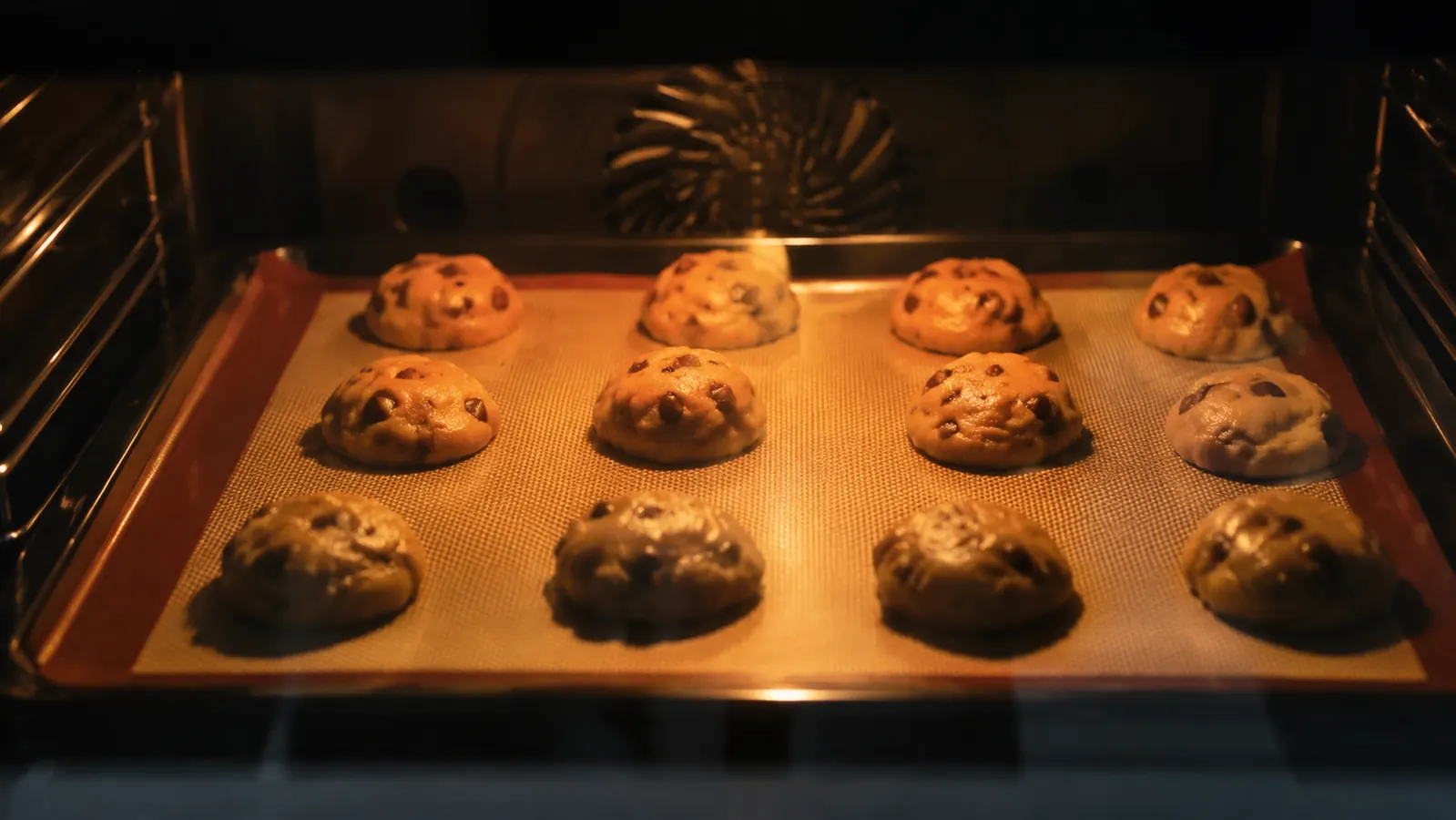
Portion your dough into balls of equal size, about 1.5 to 2 tablespoons each for a standard drop cookie, and space them at least 2 inches apart. Cookies that are too close together trap steam between them, which slows browning and leads to uneven texture. Cookies at the edges of the pan will always bake slightly faster than those at the center because they are closer to the oven walls, so leave a bit more space at the edges if possible.
Once the pan is loaded, slide it onto the center rack of the oven, not the bottom rack. The center rack positions the cookies equidistant from the top and bottom heating elements, which is the most neutral heat position in nearly every home oven. The bottom rack concentrates radiant heat from the lower element directly onto the pan floor, which is exactly what causes burnt bottoms. Even with a silicone mat, the bottom rack is too aggressive for most cookie recipes.
If your oven runs hot (many do), consider reducing the temperature by 10 to 15 degrees from whatever the recipe states. The silicone mat does the work of distributing heat, but it cannot compensate for an oven that is significantly hotter than the dial suggests.
Step 5: Bake, Check Early, and Let Cookies Rest on the Mat
Set your timer for two minutes less than the recipe calls for and check the cookies at that point. They should be just set around the edges with the center still looking soft and underdone. That is exactly where you want them. Cookies continue to bake from residual heat after they come out of the oven, especially on a hot pan. Pulling them slightly early prevents the base from overcooking during that carryover time.
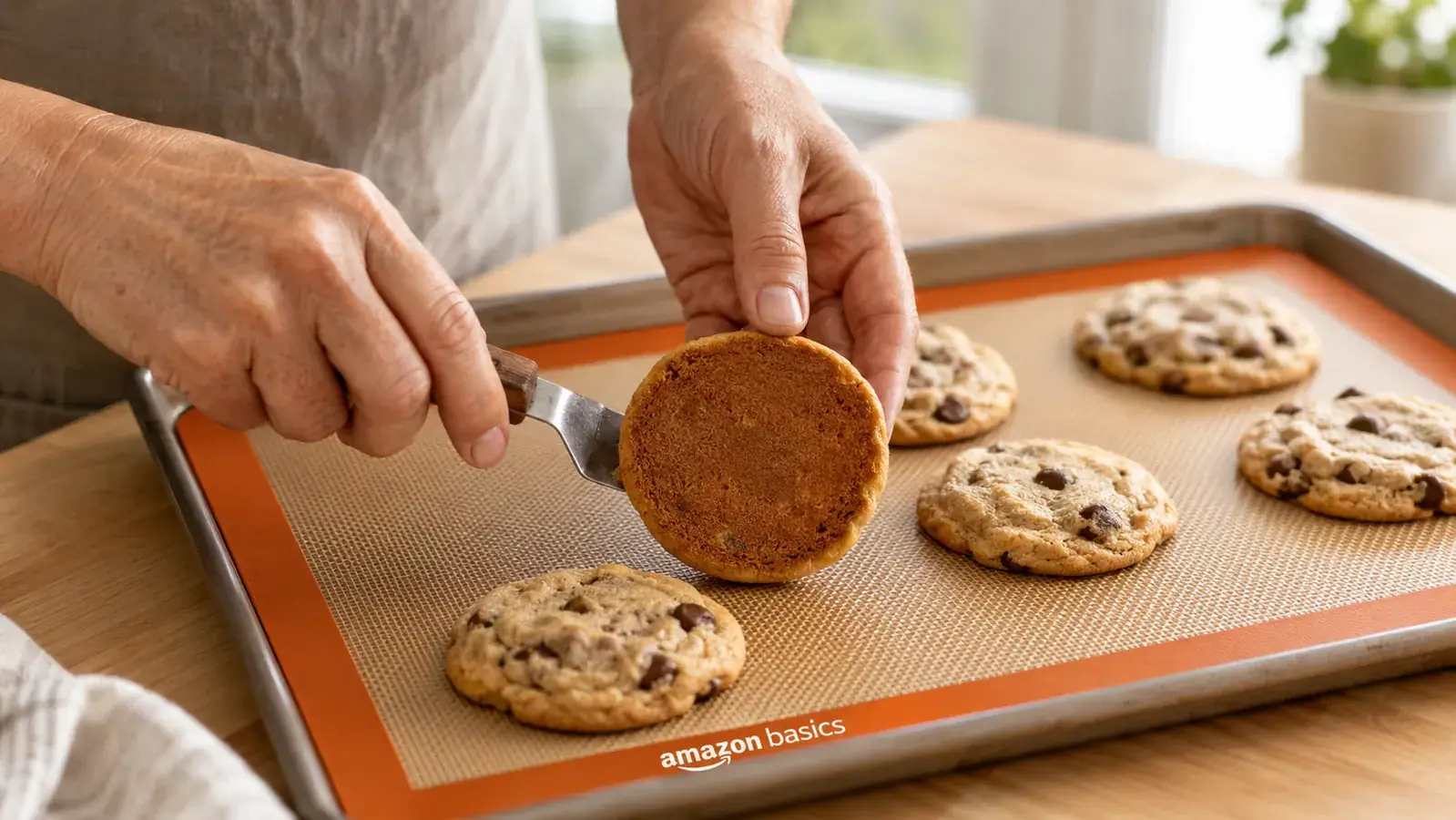
Once the pan is out of the oven, leave the cookies on the mat for two minutes before attempting to move them. The silicone holds warmth but it releases cookies cleanly once they are just slightly cooled. Try to move them immediately and they may tear or leave the bottom layer behind. Two minutes is enough. After that, slide a thin spatula under each cookie and transfer to a wire rack to finish cooling.
Flip one cookie over and look at the bottom. It should be uniformly light to medium golden, with no dark patches. If it looks right, your setup is dialed in. If the edges are darker than the center bottom, your spacing was too tight or the rack was too low. Adjust on the next batch.
What Else Helps Alongside the Mat
The silicone mat handles heat distribution, but a few other things work alongside it to give you the best results. First, use a heavy-gauge aluminum half-sheet pan rather than a thin, flimsy baking sheet. Thin dark pans conduct heat more aggressively than heavy aluminum, and they also warp under heat, which causes the mat to shift. A good rimmed half-sheet pan and a silicone mat together are a combination that is genuinely hard to beat for cookies.
Second, if you are baking multiple trays at once, rotate them halfway through. Even with a mat and a good pan, no home oven heats perfectly evenly from front to back and left to right. A halfway rotation takes ten seconds and makes a real difference in consistency across both pans. If your oven has a convection setting, the fan helps circulate heat more evenly and can shave a minute or two off bake time. Start checking even earlier when using convection.
Third, clean the mat between batches if it has any dough or sugar residue. A sticky mat transfers old sugars to fresh dough and that concentrated sugar contact point browns faster than the surrounding cookie. A quick wipe with a damp cloth between batches is all it takes. For a full clean at the end of a session, wash the mat in warm soapy water or run it through the dishwasher. The Amazon Basics mat is dishwasher safe, which is one of the main reasons I have kept it in rotation for so long.
If you want to go deeper on how the mat compares to just using parchment paper on the same pan, the silicone baking mat vs parchment paper comparison covers cost per use, heat behavior, and which one holds up better for repeat baking sessions. And if you want a full breakdown of how the mat itself performs across different tasks over time, the long-term silicone baking mat review covers eight months of daily use.
A heavy aluminum half-sheet pan plus a silicone mat is a combination that is genuinely hard to beat for cookies. The pan carries even heat. The mat buffers it.
Ready to stop throwing away burnt batches?
The Amazon Basics silicone baking mat is the tool this entire guide is built on. Rated 4.7 stars by more than 25,000 bakers on Amazon. Fits a standard half-sheet pan and cleans up in the dishwasher.
Amazon Check Today's Price on Amazon →