
If you open one can a month, you probably do not need to think about this at all. But if you cook from scratch most nights, you already know the frustration: a manual opener that slips off the rim, a lid that bends instead of releasing cleanly, or a handle that leaves your palm sore after you've worked through a recipe that calls for four cans of tomatoes. The question of electric vs manual is not really about convenience as a luxury. It is about which tool holds up to actual daily cooking without getting in your way.
The short answer: for most home cooks, the Cuisinart electric can opener wins on ease, edge safety, and everyday dependability. A good manual opener still makes sense if counter space is genuinely tight or if you only open cans occasionally. Below is the full breakdown so you can make the call yourself.
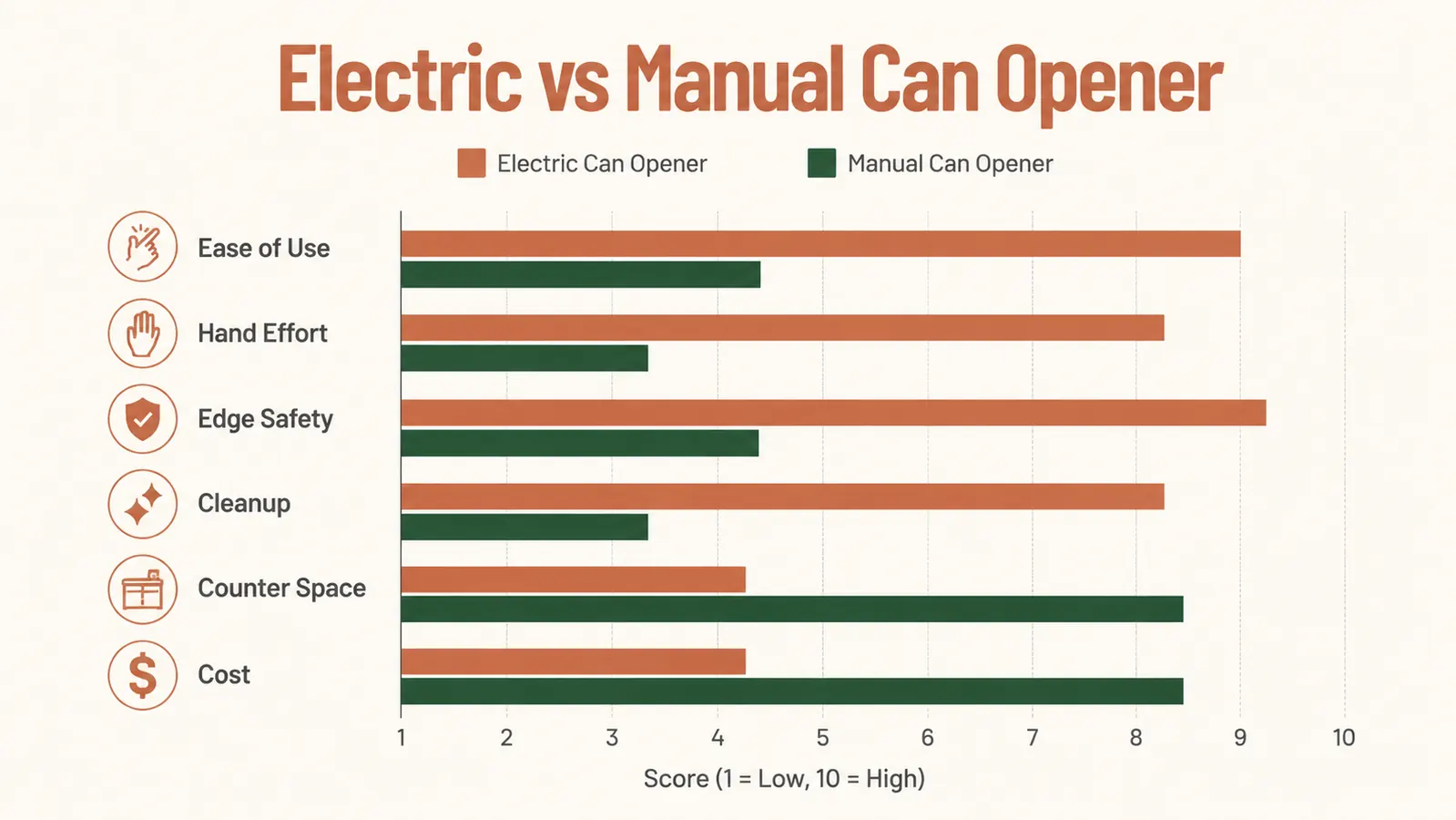
| Electric Can Opener | Manual | |
|---|---|---|
| Operation | One-touch: press lever, walk away | Two-handed turn, steady the can throughout |
| Hand / Wrist Effort | Near-zero, no grip or twisting required | Moderate to high, especially on large or thick-rimmed cans |
| Lid Edge Safety | Smooth, rolled edge, no sharp points | Sharp edge on both lid and can rim, cut risk is real |
| Speed (single can) | 15-20 seconds, fully automated | 20-40 seconds, varies by hand strength and can size |
| Cleanup | Detachable cutting assembly, rinses in seconds | One piece, rinse or dishwasher, but blade can trap food |
| Counter / Storage Space | Requires 4x5 inch footprint on counter or cabinet shelf | Fits in a drawer, takes almost no space |
| Price Range | Mid-range (Cuisinart model) | Budget-friendly for a quality OXO or Kuhn Rikon |
| Power Requirement | Needs an outlet or USB port nearby | No power source needed |
| Best For | Daily cooking, arthritis, hand fatigue, high volume | Occasional use, travel, very small kitchens |
Where the Cuisinart Electric Can Opener Wins
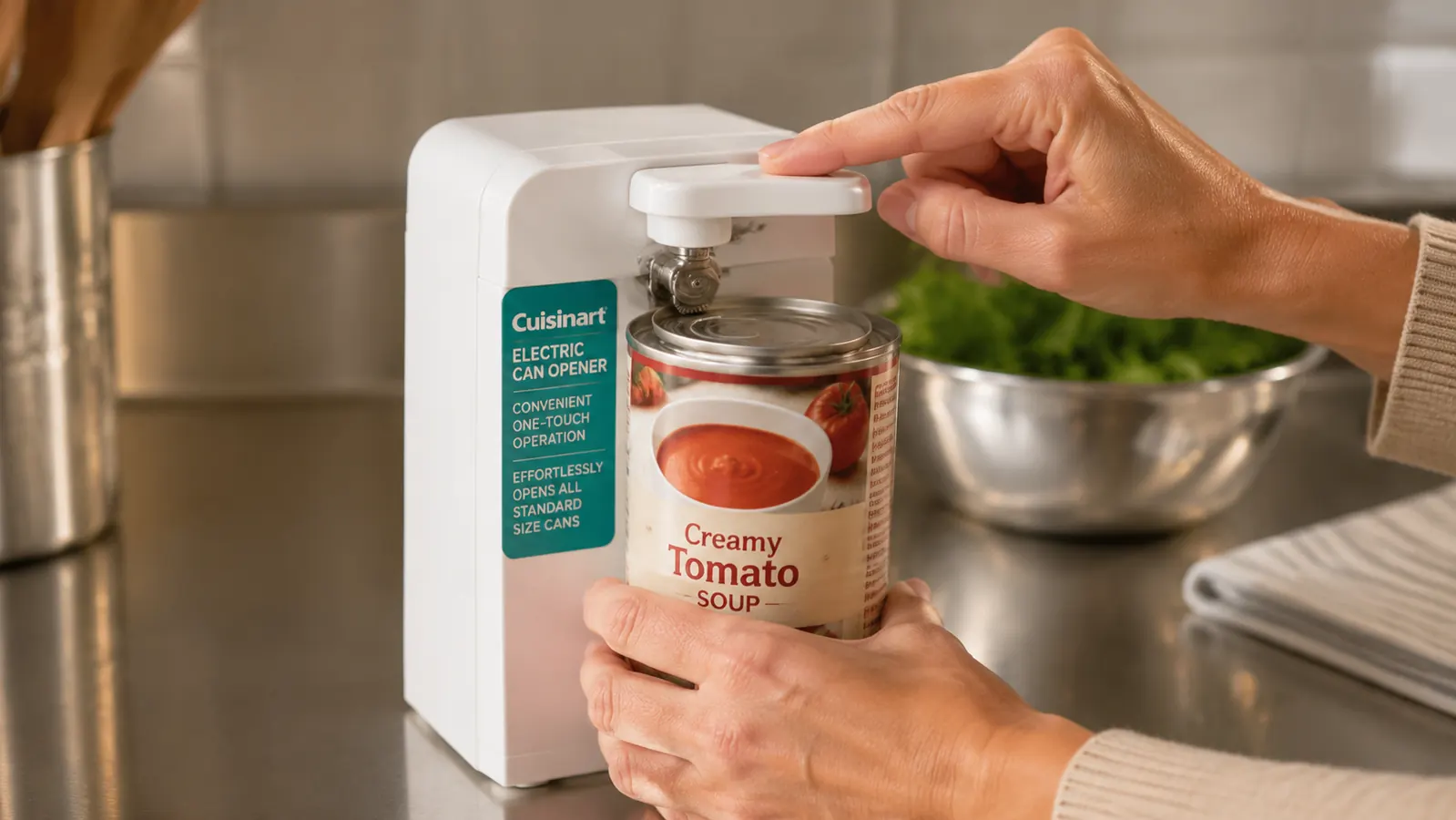
The biggest advantage is effort, and it compounds quickly when you are cooking a real meal. Making a big pot of chili on a Sunday means opening beans, tomatoes, corn, and broth, often four to six cans in a row. With a manual opener, your hand is doing real work by can three. With the Cuisinart, you press the lever once, the opener drives itself around the rim, and you move on to the next step without stopping. That one-touch operation is not a gimmick. It is the entire point, and it works exactly as advertised.
The edge safety difference is also worth taking seriously, especially if you have kids helping in the kitchen or aging family members who cook regularly. Manual openers leave a sharp, jagged edge on the lid and an equally sharp edge on the can itself. The Cuisinart cuts from the side of the lid, creating a smooth, rolled edge that will not slice a finger on contact. Over two years of daily use in my kitchen, I have not had a single cut from this opener. That is not the case with the manual opener I used before it.
Durability also tends to favor the Cuisinart at this price point. More than 63,000 Amazon ratings at 4.5 stars tells you something real about long-term reliability. The motor holds up, the magnet that lifts the cut lid off the can still works after extended use, and the cutting assembly stays sharp far longer than the blade on a typical manual opener, which dulls and slips within a year or two of regular use.
Where a Manual Can Opener Wins
If your kitchen is genuinely small, say a studio apartment or an RV, counter space is not just a preference, it is a hard constraint. A manual can opener lives in a drawer and takes up zero counter real estate. The Cuisinart sits on the counter permanently because plugging and unplugging it every use defeats the convenience entirely. If you are working with a very tight footprint, a quality manual opener like the OXO Good Grips is a reasonable, honest choice.
Cost is the other honest win for manual. A solid manual opener runs budget-friendly and does the job if you open cans infrequently. If you open one or two cans a week and your hands are in good shape, the price gap is hard to justify on pure frequency math alone. The Cuisinart earns its price over time through ease and edge safety, but if you are on a tight budget and only open cans occasionally, that is a fair place to start and upgrade later.
Open every can cleanly and without hand strain
The Cuisinart electric can opener handles one-touch operation, leaves smooth edges, and detaches for quick rinsing. Over 63,000 home cooks use it daily. Check the current price below.
Amazon Check Today's Price on Amazon →The Cleanup Reality
Cleanup is one of the most honest arguments in favor of the Cuisinart that tends to get glossed over in reviews. The cutting assembly detaches with a simple press and rinses under the faucet in seconds. There is no prying dried tomato paste out of a manual blade mechanism. The magnet cleans easily with a damp cloth. In practice, cleaning the electric opener takes about ten seconds. For most manual openers, cleanup is similarly quick under water, but the blade and gear mechanism can trap food and build up residue if you do not scrub it regularly. Neither one is difficult to clean, but the Cuisinart's detachable design gives it a slight edge in convenience.
After two years of daily cooking, I have never had a sharp edge cut me from a can opened with the Cuisinart. That alone is worth the upgrade from a manual.
What About People with Arthritis or Hand Pain?
This is where the comparison becomes especially clear-cut. A manual can opener requires a firm, continuous grip and repetitive wrist rotation. For anyone dealing with arthritis, tendonitis, carpal tunnel, or general hand fatigue from a physically demanding job, that motion is not trivial. It adds up across a week of cooking. The Cuisinart asks for nothing beyond pressing a single lever. Even people with significant grip limitations can use it independently. If hand strength or joint pain is a factor for anyone in your household, the electric opener is not just a convenience purchase, it is a practical one.
The same logic applies to older home cooks who want to keep cooking independently for as long as possible. Reducing the small physical friction points in the kitchen matters. A one-touch can opener that leaves smooth edges and requires no grip strength is one of those tools that quietly makes daily life easier without drawing attention to itself.
How the Cuisinart Holds Up Over Time
Two years in, the motor in the Cuisinart runs exactly as it did out of the box. The gear drive moves smoothly around the rim without slipping. The magnetic lid lifter still picks up lids consistently. I open somewhere between four and eight cans a week, which puts my usage well above the occasional cook but below a home that makes large batches for freezing daily. The cutting assembly has needed cleaning and nothing else. No replacement parts, no motor issues, no complaints.
The main durability caveat I would mention is that the opener works best when it is positioned correctly on the can rim. If you rush and skip the alignment step, it can slip and leave a partial cut that requires repositioning. That is a user-error issue more than a product flaw, but it is worth knowing going in. The brief practice run of placing the opener correctly becomes automatic after a few uses, and after that it is a tool you stop thinking about entirely.

Who Should Buy the Cuisinart Electric Opener
You cook from scratch most nights and open at least three to five cans a week. You care about edge safety, either for yourself or for other people in your kitchen. You have counter space for a small appliance that earns its footprint through daily use. You have any amount of hand, wrist, or grip discomfort that makes repetitive twisting motions worth avoiding. If two or more of those apply, the Cuisinart is the right call. It is not a flashy gadget. It is a reliable kitchen workhorse that removes a small friction point from your daily cooking routine and keeps removing it for years.
Who Should Stick with a Manual Opener
You live in a studio or have a kitchen where every square inch of counter space is spoken for. You open cans two or three times a month at most. You are buying for camping, travel, or a space without a reliable outlet nearby. You are on a very tight budget and need to keep the cost low. In any of those cases, a quality manual opener like the OXO Good Grips is a perfectly honest answer. It will not match the Cuisinart on ease or edge safety, but it will open your cans without drama and take up no counter space doing it.
If you are in the majority, though, cooking real meals most nights and opening a meaningful number of cans each week, the Cuisinart is the tool that will make you wonder why you waited. I kept a manual opener for years out of habit and inertia. Switching was a decision I made after a particularly frustrating night of cooking that required six cans and left my wrist aching. That is not a decision I have second-guessed once.
For more detail on the Cuisinart's long-term performance, check the full two-year review. And if you want step-by-step guidance on getting the most from an electric opener, including tips for correct placement and cleaning, the how-to guide covers everything you need to know.
Ready to stop fighting with your can opener?
The Cuisinart electric can opener gives you smooth edges, one-touch operation, and over two years of reliable performance in a kitchen that gets real daily use. See today's price on Amazon.
Amazon Check Today's Price on Amazon →